Here's a number that should bother every founder more than it does: right now, while you're reading this, people are on Reddit, X, Bluesky, Hacker News, and Facebook asking for exactly what you sell. Not vaguely. Not eventually. They are literally typing "does anyone know a tool that does X?" where X is your product. And you're not in the room.
That's the most expensive gap in early-stage growth, and almost nobody talks about it. We obsess over ads, funnels, and content calendars while the warmest leads that will ever exist are being handed to whoever happens to reply first. Usually a competitor.
01The warmest lead is a public question
Think about the intent ladder. A cold email lands on someone who never asked. A retargeting ad chases someone who bounced. An SEO article catches someone doing early research. All useful, all several steps removed from "I want to buy."
Now compare that to someone posting: "I run a small SaaS and need a way to monitor Reddit for mentions of my product, any recommendations?" That person has raised their hand in public, described their problem in their own words, and explicitly asked for a solution. There is no warmer lead in existence. It doesn't need to be nurtured. It needs to be answered, fast, by someone helpful.
This is demand capture, not demand generation. You're not creating want; you're meeting want that already exists and is being spoken out loud. It's the highest-ROI channel most founders completely ignore, because catching those moments is genuinely hard to do by hand.
02Why doing it manually quietly fails
Every founder who's tried "just check Reddit for leads" knows how it goes. You run a few searches, find a couple of decent threads, reply, and feel great. Then real work takes over, a week passes, and you never do it again. The good threads keep appearing; you're just not there for them.
Here's what actually doing it properly costs you every single day:
Two hours a day is a full part-time job, and it still doesn't work, because the best conversations happen while you're asleep, in a meeting, or watching a subreddit you forgot existed. By the time you find a high-intent thread, it's three days old and buried under twelve other replies. The window on these things is minutes, not days.
The manual approach fails not because founders are lazy, but because the task is a real-time monitoring problem, and humans are terrible real-time monitors.
Free AI GTM checklist
The step-by-step checklist I use to launch AI products. Positioning, pricing, channels, and metrics, all in one page.
03What real-time buyer-intent monitoring actually does
This is where RedReplier reframes the whole thing. Instead of you hunting for conversations, the conversations come to you the instant they happen.
The model is simple:
- 1Add your keywords once. The phrases your buyers use, your product category, your competitors' names, the problems you solve.
- 2It watches every platform continuously. Reddit (all subreddits, no restrictions), X/Twitter, Bluesky, Hacker News, and Facebook, all at the same time.
- 3You get pinged the moment someone matches. Email alerts as often as every 15 minutes, so you can reply while the thread is still warm.
- 4Each match arrives pre-ranked. Scored by buyer intent, product fit, and freshness, with AI relevance grading so you skip the noise and spend time only on conversations worth joining.
- 5Full context is right there. The whole thread, so you can lead with a real, useful answer instead of a canned pitch.
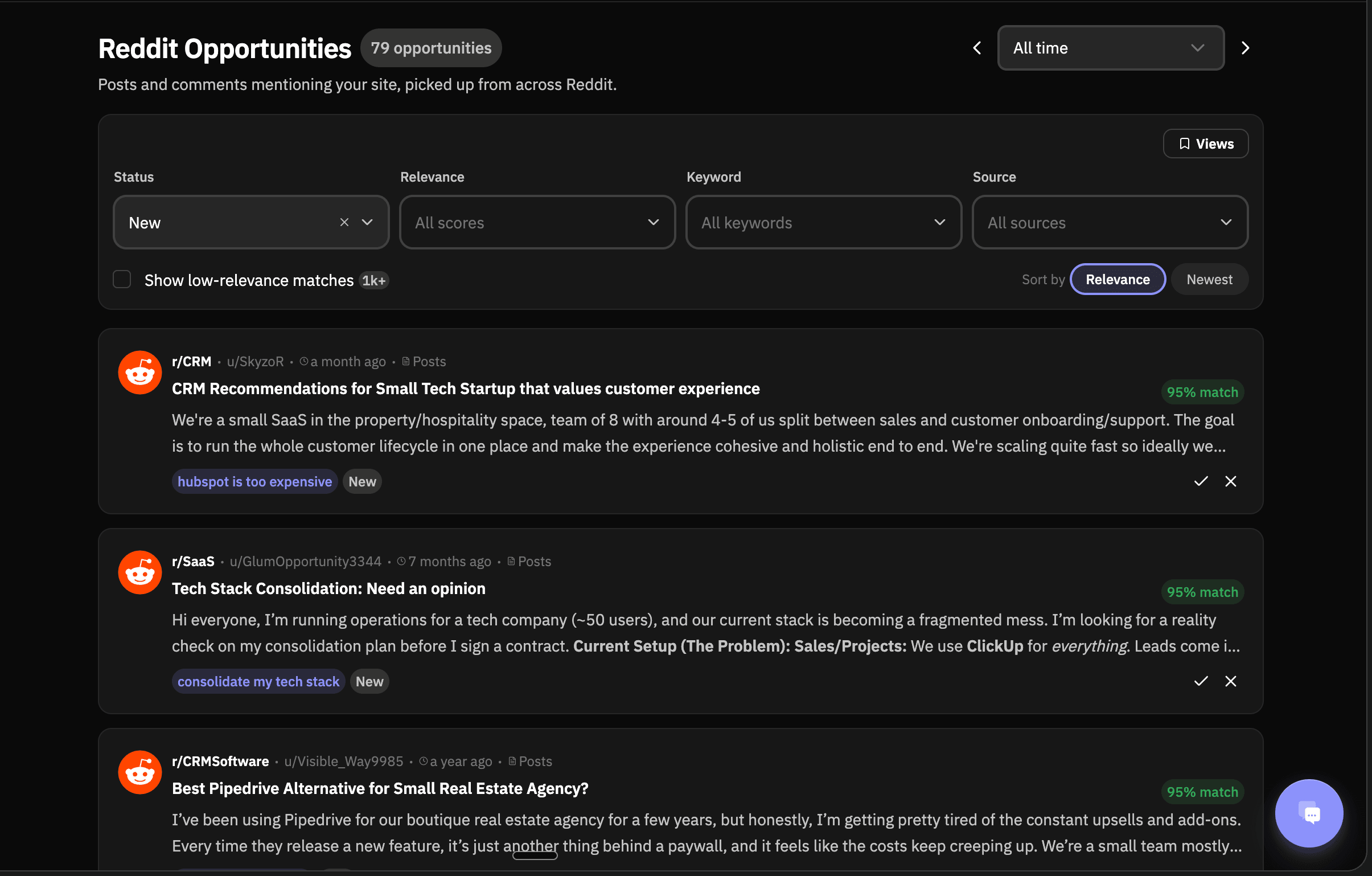
The RedReplier opportunities feed: real Reddit posts and comments mentioning your space, each scored by relevance and buyer intent so you can act on the best ones first.
The shift is from searching to being notified. You stop doing two hours of daily detective work and start doing the only part that matters: writing a genuinely helpful reply to someone who just asked.
04The part i actually love: value-first replies compound
Most lead channels are a treadmill. You stop paying, the leads stop. Ads, especially, are pure rented attention.
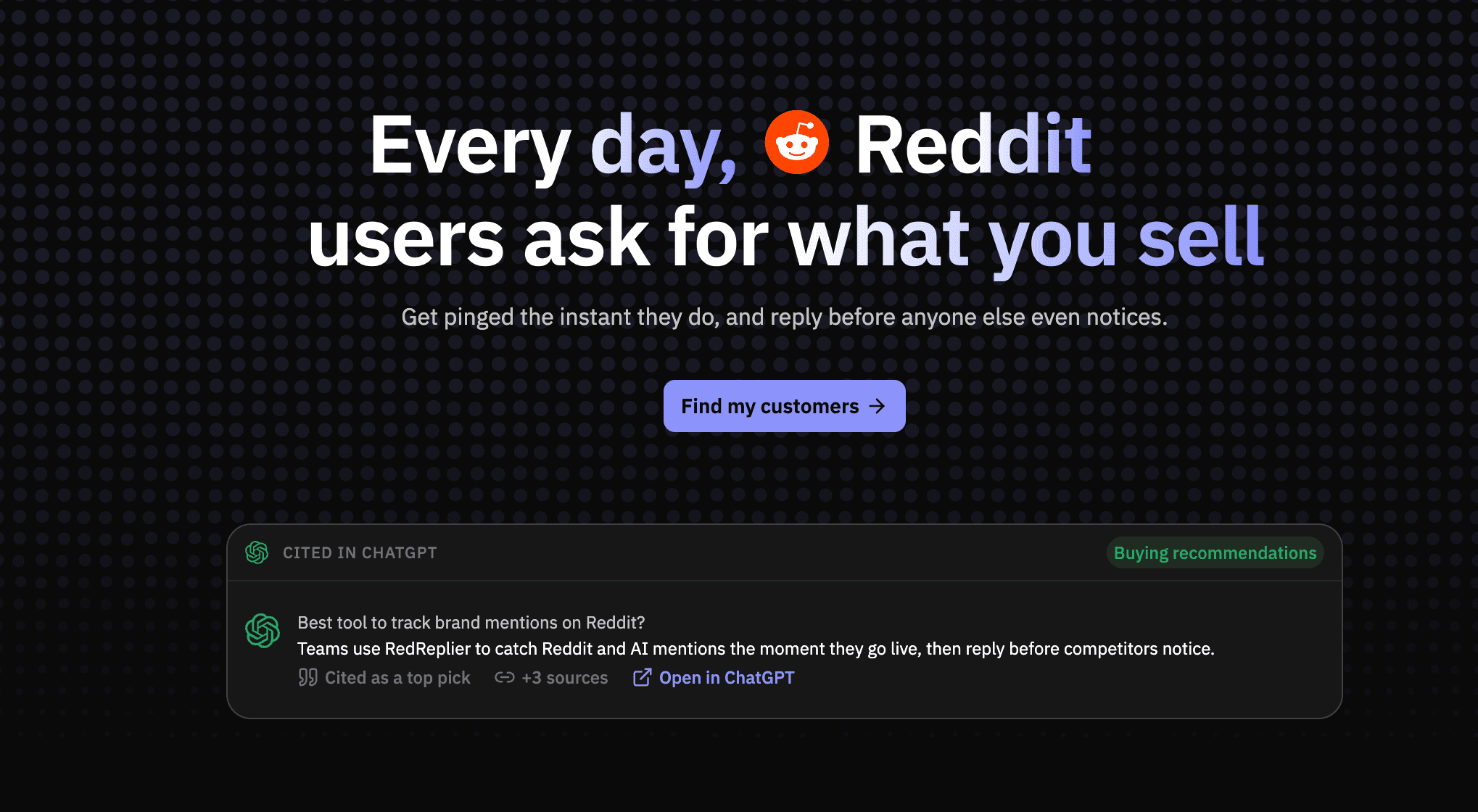
RedReplier surfaces threads that are cited in ChatGPT as buying recommendations, showing how a single helpful reply keeps working inside AI answers long after you post it.
Social replies are different, and this is the insight that made me a believer. Reddit and forum threads rank incredibly well on Google, and they're among the most-cited sources in AI answers from ChatGPT, Claude, and Gemini. So when you leave a genuinely helpful reply on a thread that ranks for your keyword, that reply keeps working. For months. Every time someone searches that question, or asks an AI model, your answer is sitting right there.
One good reply becomes a passive, compounding lead source. RedReplier even shows you which threads rank on Google and which get cited by AI models, so you can prioritize the conversations that will pay you back the longest. That's not social media marketing; that's building durable distribution one helpful answer at a time. If you've read my take on building distribution without spam, you know this is exactly the kind of compounding, relevance-first growth I think indie founders should be chasing.
05How to reply without being the spammy guy
None of this works if you show up and dump links. That gets you downvoted, banned, and remembered for the wrong reasons. The rules are simple and non-negotiable:
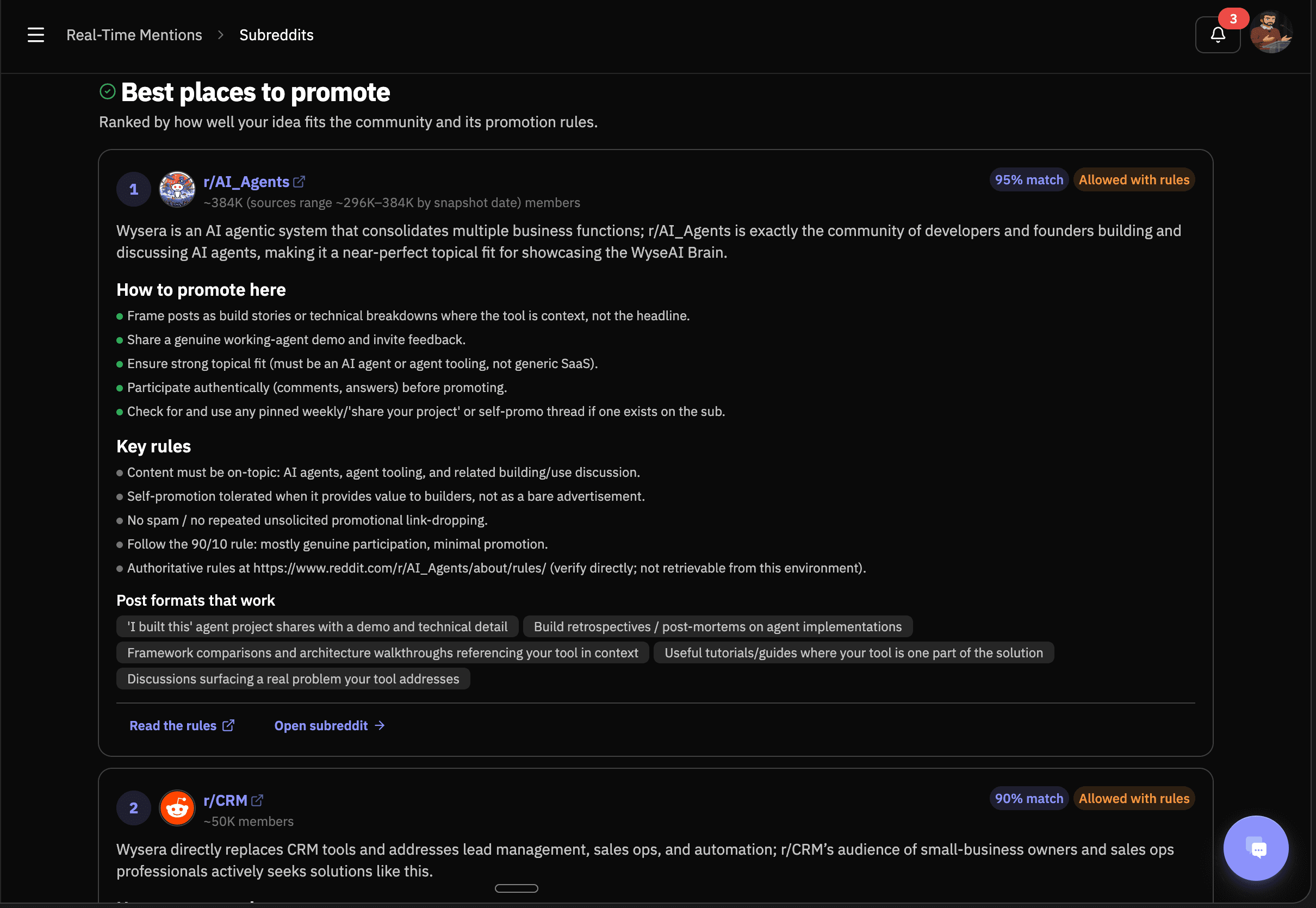
RedReplier ranks the best communities to engage in and spells out each one's promotion rules, including the 90/10 genuine-participation ratio, so you contribute the right way instead of getting banned.
- Lead with the answer, not the link. Solve the person's problem in the reply itself, whether or not they ever click through.
- Mention your product only when it genuinely fits. If it's the right answer, say so plainly and disclose that it's yours. If it isn't, recommend something else. Trust compounds too.
- Earn the right to link. A link belongs in a reply that already helped. Never the other way around.
- Show up early and often, not spammy and rarely. Being consistently useful in your niche is the entire game.
Monitoring tools make this easier, not sleazier, because they get you into the right conversations early enough to actually help, instead of forcing you to spray links across threads to hit volume.
06How to think about it as a founder
If you take one thing from this, make it this reframe: the best lead source you have isn't a channel you build, it's a conversation you join.
Concretely:
- 1Treat buyer-intent questions as inbound. Someone asking for what you sell is a warmer lead than anything in your CRM. Answer them like it.
- 2Optimize for speed. The first helpful reply wins. Set up alerts so "the instant it happens" is a real capability, not an aspiration.
- 3Write for the next thousand readers, not just the poster. On a thread that ranks, your reply is a landing page. Make it worth finding.
- 4Play the long game. Helpful now, cited later. This is the rare growth channel that gets stronger while you sleep.
07The bottom line
Your customers are telling you what they want, in public, in their own words, every single day. The only question is whether you're in the room when they do it. Manual monitoring can't keep that window open; real-time, intent-ranked alerts can. Add your keywords once, reply first with something genuinely useful, and let the threads that rank keep paying you back long after you hit send.
Stop chasing attention you have to rent. Start answering the people already asking. If you want to see what real-time buyer-intent monitoring looks like across Reddit, X, and beyond, RedReplier is built for exactly this.